Equipment
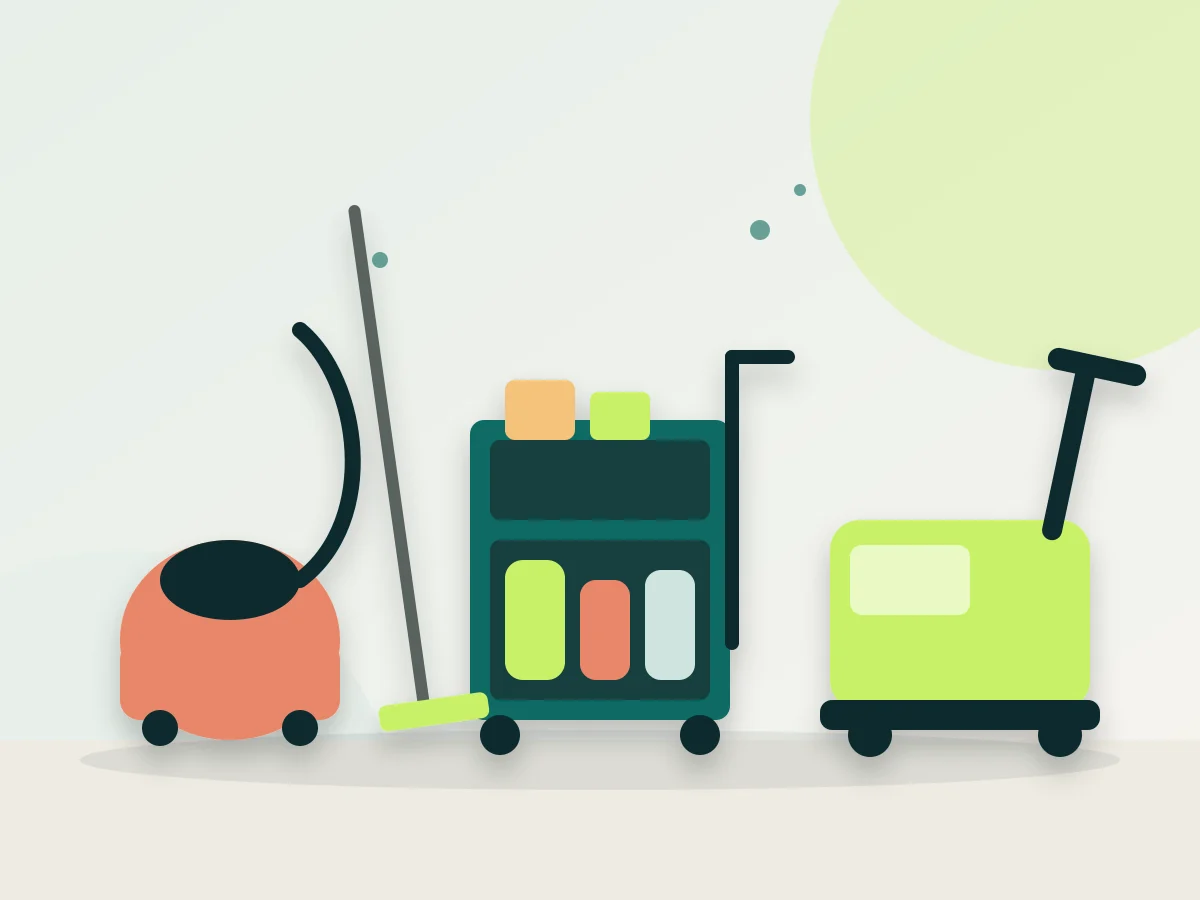
Cleaning equipment and supplies for starting out – the basics
Good equipment saves time – and time is money in cleaning. What you really need and what to look for.
Contents
This article contains advertising (affiliate) links, marked “Ad”. How we label ads
In short: For contract cleaning you need a robust professional vacuum, a colour-coded microfibre system, a mop system, a cleaning trolley, a dosing aid and protective gear. A scrubber dryer only pays off for large hard floors. Criteria: durability, service, spare parts – and ease of use for your staff. As of October 2026.
In our cleaning company in Vienna we learned early that cheap equipment is expensive. A household vacuum that dies after three months of daily use costs you not just a new machine but time, stress and sometimes a missed job. At the same time you don’t need to buy everything on day one – much of it can be rented or added later.
Basic kit per cleaning team
| Equipment | Purpose | Criteria |
|---|---|---|
| Professional vacuum | Carpet, hard floor | Weight, filter, noise, spare parts |
| Colour-coded microfibre | Surfaces by area | One colour per area, washable |
| Mop system | Hard floors | Flat or damp mopping, replaceable pads |
| Trolley | Order, short distances | Space for supplies, bags and mops |
| Dosing aid | Correct concentration | Simple, traceable |
| Protective gear | Gloves, goggles if needed | Matching the safety data sheets |
| Step ladder | High surfaces | Tested, stable, fit for purpose |
| Wet-floor signs | Slippery floors | Clearly visible, pictograms |
The vacuum
For offices, a professional canister vacuum is the most important machine. Look at:
- weight and portability – stairs and lifts are part of daily work,
- filtration (higher filter classes for medical practices, for example),
- noise level – important if you clean during business hours,
- cable length and robust hoses,
- spare parts and service nearby.
Backpack vacuums are faster on stairs and in cluttered sites but need training. Cordless machines save cable handling but have limited run time – check whether one battery lasts a whole site.
Why colour coding?
A colour system (one colour per area) stops cloths from the toilets ending up in the kitchen. It is easy to teach – even across language barriers. A common scheme:
| Colour | Area (example) |
|---|---|
| Red | Toilets, urinals |
| Yellow | Washbasins, tiles in washrooms |
| Blue | Offices, furniture, general surfaces |
| Green | Kitchen, food areas |
The exact scheme matters less than using the same one everywhere and writing it into the service specification or hygiene plan.
Mop system
For hard floors in offices, flat-mop systems with pre-soaked pads work well: a fresh mop for each room. That is more hygienic than one bucket for a whole floor and saves water and chemicals. Plan for a washing machine or laundry service.
Cleaning agents
Less is more: an all-purpose cleaner, a sanitary cleaner (acidic, for limescale), a glass cleaner and specialist products only where needed. Keep safety data sheets at hand, train correct dosing and store chemicals separately and labelled. Dosing systems cut consumption noticeably.
For delicate surfaces (natural stone, parquet, stainless steel): check the manufacturer’s instructions first. Wrong products are a frequent cause of damage – and of discussions with your insurer: Insurance for cleaning companies – what you really need.
Machines: buy, rent or lease?
A scrubber dryer pays off for large hard floors used regularly. For deep cleaning a single-disc machine you rent is often enough at first. Rule of thumb: buy what you use every week, rent what you need a few times a year.
Orders of magnitude (October 2026, no guarantee): professional vacuums mostly in the low to mid three-figure euro range, trolleys similar, scrubber dryers quickly four or five figures. Compare offers and ask about demo machines.
Cost example (assumptions): a scrubber dryer at €6,000 net, five-year life, used 10 hours a week (about 450 hours a year): depreciation alone is roughly €2.70 per operating hour, plus maintenance and pads. If it saves you an hour of staff time per job compared with mopping, it pays off quickly – otherwise it doesn’t.
Safety and training
- Gloves suited to the chemicals, goggles where needed
- Safety data sheets available, never decant without labelling
- Ladders tested and suitable; work at height has its own rules – special cleaning: Contract, deep and special cleaning – differences and pricing
- Document training: Registering employees in Austria – employer account, ELDA, written statement
In your pricing
Materials and equipment belong in your hourly rate – as a flat rate per hour or per site: Calculating the hourly rate for cleaning – the right way. Our example uses €1.50 per hour; check your real figure after a few months.
Start-up checklist
- Professional vacuum (per team, plus a spare)
- Cleaning trolley with mop and bag holders
- Microfibre cloths in four colours, enough for wash cycles
- Flat-mop system with pads
- Basic range of cleaning agents, dosing aid
- Gloves, wet-floor signs, step ladder
- Washing machine or laundry service
- Storage space and transport
Care and maintenance – so the kit lasts
- Vacuums: change filters and bags regularly, check cables and hoses for damage
- Microfibre: wash as the manufacturer recommends, no fabric softener, separated by colour
- Mops: wash after every use and dry completely
- Trolleys: clean weekly, check the wheels
- Machines: keep to service intervals, replace pads and brushes in time
Keep a short card for every larger machine: purchase date, serial number, services, repairs. It helps with warranty claims, insurance and deciding when replacement is cheaper than the next repair.
Common mistakes
- Household appliances in continuous professional use
- Too many different cleaning products
- No colour system – hygiene issues and complaints
- Buying an expensive machine before utilisation is clear
- No spare machines – one breakdown stops the whole route
Frequently asked questions
Buy or lease?
For expensive machines, leasing or renting can make sense until utilisation is clear.
Which products do you really need?
For contract cleaning a few standard products are usually enough; specialist products only for specific requirements.
Who supplies materials – us or the client?
Usually you supply cleaning agents and equipment, while consumables (paper, soap) are agreed separately. Put it in the quote: Writing a quote for contract cleaning – with service specification.
Does every site need its own equipment?
Large sites cleaned daily, yes – a fixed storage room saves transport time. Small sites are usually served with mobile kit.
How much start-up budget do I need for equipment?
For a small contract-cleaning team a low four-figure sum is often enough for vacuums, trolley, mop system, cloths and products. Deep-cleaning machines can be rented at first. Keep a reserve for spare equipment.
Read next

Founding
Starting a cleaning company in Austria – step by step
From the right trade licence to the first registration with the health insurance fund – the process as it really works in Austria, including the pitfalls.
Pricing
Calculating the hourly rate for cleaning – the right way
Why €15 an hour almost always means a loss – and how to get from the collective-agreement wage to an hourly rate that carries your business.

Founding
Trade licence for cleaning in Austria – building cleaning (regulated) or caretaking (free)?
Office cleaning with the free trade? This is where the costliest start-up mistakes happen. The distinction with examples – and how registration works.